
When Shame Turns Into Anger
The door slam that wasn't about the door
The following is a composite example drawn from patterns I see often in my practice.
He's a senior associate at a Midtown firm. In a client meeting, a partner corrected his numbers in front of everyone, mid-sentence. He smiled, said "good catch," and kept going.
Two hours later, his train sat stalled under the East River for twenty minutes. When he got home, his wife asked why he was late. He slammed the bedroom door hard enough to rattle the frame.
He came to therapy wanting help with his temper. In therapy, we traced the reaction back to the meeting. Being corrected had landed not simply as "I made a mistake," but as "Everyone can see I'm not good enough." The frustration of the commute added to it. By the time he got home, he was reacting to more than his wife's question.
That is the pattern this post is about. Anger isn't always about shame. But sometimes, anger is a way of escaping it.
Anger as an escape from shame
Shame can feel unbearable, so the mind looks for a way out. Anger is one of the quickest. It turns I've been exposed into you're out of line, and for a moment, the pain of feeling small is replaced by the energy of feeling wronged.
The relief doesn't last. The person on the receiving end gets hurt, the relationship takes a hit, and afterward there is often something new to feel ashamed about. The cycle can keep feeding itself.
Research supports this connection. June Tangney and her colleagues studied roughly 500 undergraduates across two studies. Those most prone to shame also scored higher on anger, irritability, resentment, suspiciousness and blaming others. Those prone to guilt, without the shame, were less likely to blame others (Tangney et al., 1992).
"I did something bad" vs. "I am bad"
To see why shame and anger can travel together, it helps to separate shame from guilt.
Guilt is about an action. I missed the deadline. I was rude to my brother. It hurts, but it points toward a fix: apologize, repair, do better.
Shame is about the whole self. I'm incompetent. I'm a fraud. Something is wrong with me. It can feel as though there's nothing to fix, only something to hide.
Guilt tends to draw people back toward each other. Shame tends to push them away. As psychologist Mark Zaslav notes, shame often comes with "an urge to hide or blame others" (Zaslav, 1998).
The critic you carry
Everyone feels a flash of shame now and then. It passes, and it can even help us read a room. The trouble starts when shame stops being a passing feeling and becomes a belief about who you are.
That belief often has a history. People who grew up with a lot of criticism, mockery or cold disapproval may absorb those voices. Over time, the critical parent, coach or older sibling doesn't need to be in the room. The voice has moved inside: You blew it again. What's wrong with you?
Zaslav describes shame as an inner drama between two characters: a self that feels small and flawed, and a critic who looks down on it. In adulthood, that critic can get projected onto whoever seems to be judging you: a boss, a partner, a stranger who cuts in line. When anger feels out of proportion to the situation, it may be partly aimed at that old critic rather than the person in front of you.
Pressure, competence and looking weak
Many of the men I work with describe an unspoken rule: don't look weak. For some men in New York's high-pressure workplaces, that rule can feel especially familiar. In finance, law, media and restaurant kitchens, people are ranked, reviewed and compared constantly, often in public. A bad quarter, a lost client or being passed over for promotion can land as a verdict on who you are, not just how you did.
The city adds its own friction: packed trains, cramped apartments, long hours and little privacy. Many people also carry family expectations about providing and succeeding. When feeling small doesn't seem allowed, anger may feel more acceptable than admitting hurt, fear or inadequacy.
This pattern isn't limited to men. Anyone whose sense of worth is tied to competence, or who learned early that vulnerability wasn't safe, may recognize it.
Where does your shame go? The Compass of Shame
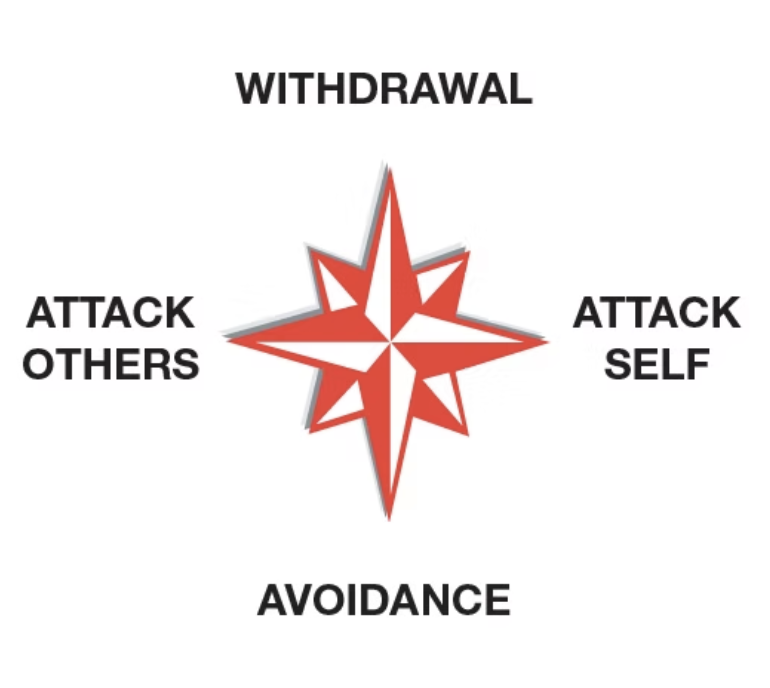
Shame doesn't always become anger. Psychiatrist Donald Nathanson described four directions people move to get away from it, which he called the Compass of Shame (Nathanson, 1992).
Attack Others. Turning the tables, blaming, lashing out. Cursing out a cab driver, or tearing into a junior colleague on Slack after your own work was criticized.
Attack Self. The harsh inner critic. Lying awake replaying the meeting, calling yourself an idiot.
Withdrawal. Hiding and isolating. Cancelling plans, going quiet at home for days.
Avoidance. Numbing or distracting. A few too many drinks after work, gambling, working until midnight so there's no time to feel anything.
The anger other people see is usually the Attack Other point. But most people don't stay in one place. A common pattern is to explode, then turn on yourself, then withdraw. Recognizing when shame is driving this cycle is often a turning point.
Researchers have since developed a questionnaire to measure these four styles and found that they relate in distinct ways to anger, self-esteem and psychological symptoms (Elison, Lennon & Pulos, 2006).
What changes in therapy
Breathing exercises and timeouts have their place, and I teach them. When shame is part of the pattern, addressing it can also be an important part of change. In my practice, that often involves:
Rewinding the tape. We replay a recent blow-up in slow motion and look for the moment just before the anger: the moment you felt criticized, dismissed or exposed.
Putting words to it. Shame thrives on secrecy. Being able to say "that was humiliating" to another person is often a relief in itself.
Mapping your pattern. Using the Compass of Shame, we figure out where you tend to go: outward, inward, away or numb.
Shifting from shame to guilt. "I'm a bad husband" leaves you defensive. "I yelled, and I want to repair it" gives you somewhere to go.
Having a plan for the hot moment. When anger rises fast, you need practical ways to step back before you do damage. As Zaslav observes, unchecked rage tends to leave "more consequences to be ashamed about."
Shame may show up in the therapy room too: an abrupt change of subject, averted eyes, an awkward laugh, or irritation at the therapist. Those moments aren't setbacks. They often mean we're near something important, and they are a signal to slow down rather than push.
Recognizing the moment before
The goal isn't to become someone who never feels embarrassed, criticized or angry. It's to recognize what happened before those feelings turn into something you regret.
For the man in the opening example, the work was learning to distinguish "I got a number wrong" from "I'm not good enough," and to take responsibility for what happened when he got home.
If this pattern feels familiar, I offer online anger therapy for adults throughout New York State. Book a free consultation to discuss what you'd like to change.
Frequently asked questions
Is anger always a cover for shame? No. Anger can be a healthy response to real unfairness. Shame is worth exploring when your anger feels bigger than the situation, keeps repeating, or leaves you feeling worse afterward.
How does your approach combine anger-management skills with deeper work? In my practice, we work on both what happens during an angry moment and what makes that moment so charged. That means developing practical ways to interrupt an outburst while exploring the criticism, hurt or fear of inadequacy that may be feeding it.
I don't feel ashamed, just angry. Does this still apply? It might. Shame can pass so quickly that all you notice is the anger. Many people only recognize it once we slow an episode down together.
How long does therapy take? The pace varies. We'll review together what is changing and what still feels difficult. Changing a long-standing inner critic usually takes time.
References
Elison, J., Lennon, R., & Pulos, S. (2006). Investigating the Compass of Shame: The development of the Compass of Shame Scale. Social Behavior and Personality, 34(3), 221–238. Journal
Nathanson, D. L. (1992). Shame and Pride: Affect, Sex, and the Birth of the Self. W. W. Norton.
Tangney, J. P., Wagner, P., Fletcher, C., & Gramzow, R. (1992). Shamed into anger? The relation of shame and guilt to anger and self-reported aggression. Journal of Personality and Social Psychology, 62(4), 669–675. PubMed
Zaslav, M. R. (1998). Shame-related states of mind in psychotherapy. Journal of Psychotherapy Practice and Research, 7(2), 154–166.